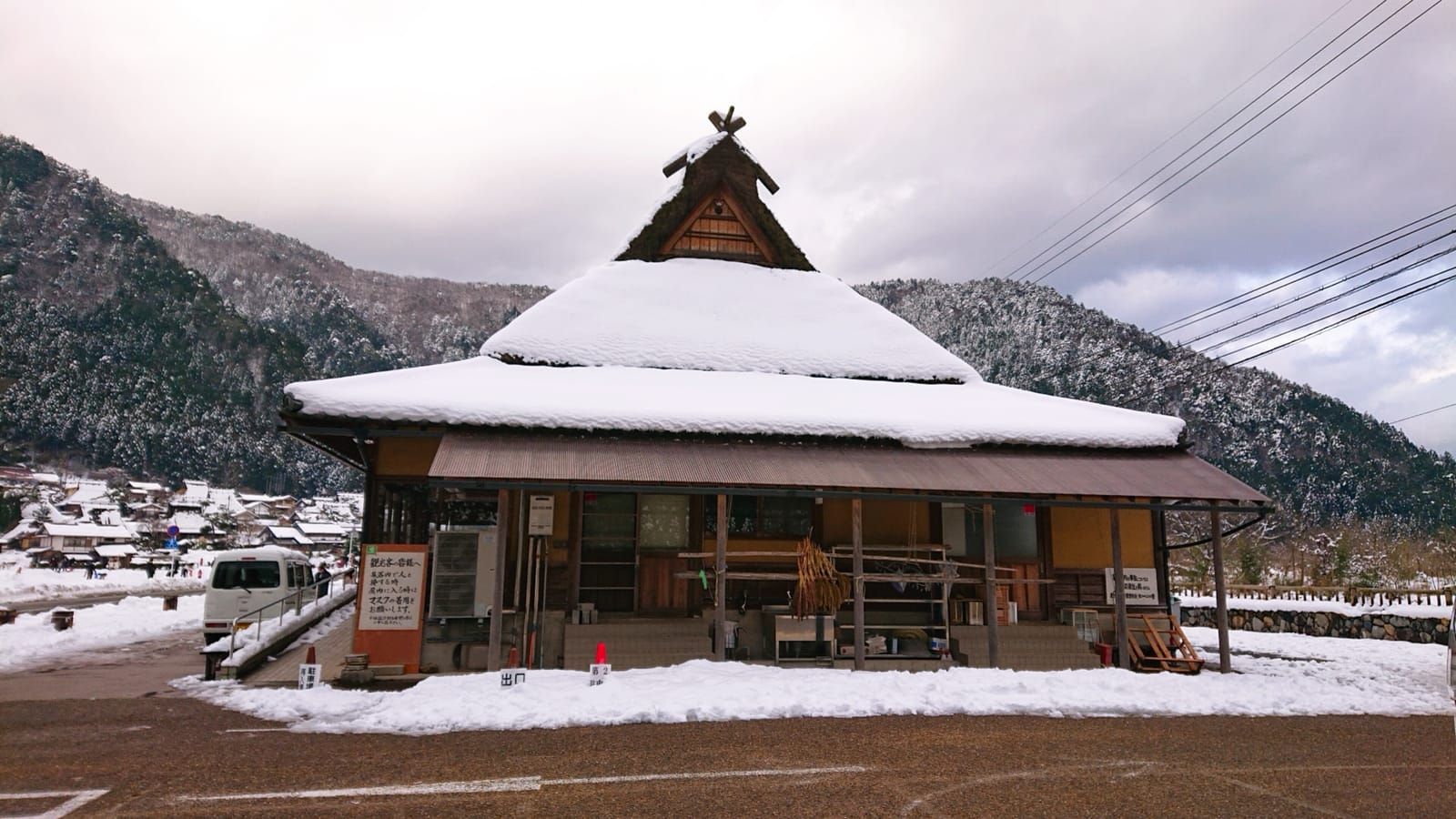
Ninety minutes north of Kyoto Station, in a valley of the Nantan hills, is a hamlet of fifty houses, thirty-nine of them still thatched — Kayabuki no Sato in Miyama, a nationally protected preservation district since 1993. In the second half of winter it holds the one event that puts it on international lists: a week of evenings when the lanes are lit with candle lanterns against (in a good year) snow-loaded roofs. Two things have changed that most English guides have not caught up with. The festival was renamed in 2026 — “Winter Lantern Festival” (冬灯廊), not “Snow Lantern Festival” (雪灯廊) — because, in the organizers’ own words on the official site, the snow had stopped reliably turning up (“降雪不足が続いているため”). And the 2027 dates are already published. Here is the event as the organizers describe it, the honest transport situation (you cannot do the evening by public transport and get home), the snow and cold in numbers, and where you can sleep.
The short answer: January 30 – February 6, 2027, lanterns lit 17:00–19:00 nightly, free entry. Stay the night in or near the village — the last bus out leaves hours before the lanterns are lit — and come by the JR Sagano line to Hiyoshi and the Nantan city bus, or by car on winter tyres.
Winter Lantern Festival 2027 at a glance (official site, checked 2026-10-27)
| Item | Detail |
|---|---|
| Name | Miyama’s Thatched-Roof Village Winter Lantern Festival (冬灯廊; the 22nd edition). Renamed from “Snow Lantern Festival” (雪灯廊) from the 2026 edition “because of ongoing snow shortages” |
| Dates | Saturday January 30 – Saturday February 6, 2027 (8 days) |
| Lanterns lit | 17:00–19:00 each evening |
| Food stalls | 15:00–19:00 |
| Extras | Mochi and zenzai (sweet bean soup) 17:15–18:15, ¥300 (free on Feb 3); a dance offering on Feb 3, 17:45–18:05, ¥500. No fireworks |
| Admission | Free for walk-in visitors |
| Parking | Pre-booked and prepaid only: ¥1,500 per car (80 spaces), ¥10,000 per coach; lot open 16:00–19:00; bookings opened 2026-09-07 |
| Shuttle / direct bus | None. The organizers state there is no plan for the Keihan Kyoto Kotsu direct “Kyoto–Miyama” bus in 2027 |
| Previous edition | 2026: January 19–23 (five days), 17:00–19:00 |
The tourism office (Miyama Navi) also sells a day bus tour from Kyoto Station’s Hachijo exit for ¥12,000 during the festival; its listing mentions a “¥1,500 venue ticket” even though admission is free, so check what the fare includes before booking.
Why a tour is the realistic answer for the lanterns: by train and bus the evening cannot be done — the last bus out of the village leaves between 16:54 and 18:25 depending on the day, and the lanterns are lit at 17:00 (details below). Unless you are sleeping in the valley or driving on winter tyres, the way most visitors see the lanterns is a coach. The Klook tour below runs a “winter-limited lantern plan” that shifts its departure so the Miyama stop falls after dark, after Amanohashidate and the Ine Bay boat earlier in the day; it leaves from Osaka (Dotonbori, 9:30) or Kyoto, drops you in the same city, carries guides in English, Chinese and Japanese (the listing warns a specific language cannot be guaranteed), and allows free cancellation up to 24 hours before (Klook, checked 2026-10-27). Confirm on the booking calendar that your date falls inside the January 30 – February 6 window — outside it the same tour runs its daytime “classic” route.
Book ahead · Klook
Miyama Winter Lantern Festival + Amanohashidate + Ine Bay boat — one-day tour from Osaka/Kyoto
Amanohashidate, the Ine Bay boat and the Miyama lanterns after dark in one day, from Osaka or Kyoto — check that your date is on the winter-limited lantern plan and what the package includes.
Check availability →Affiliate link — a small commission may go to Beyond Kansai at no extra cost to you. Disclosure.
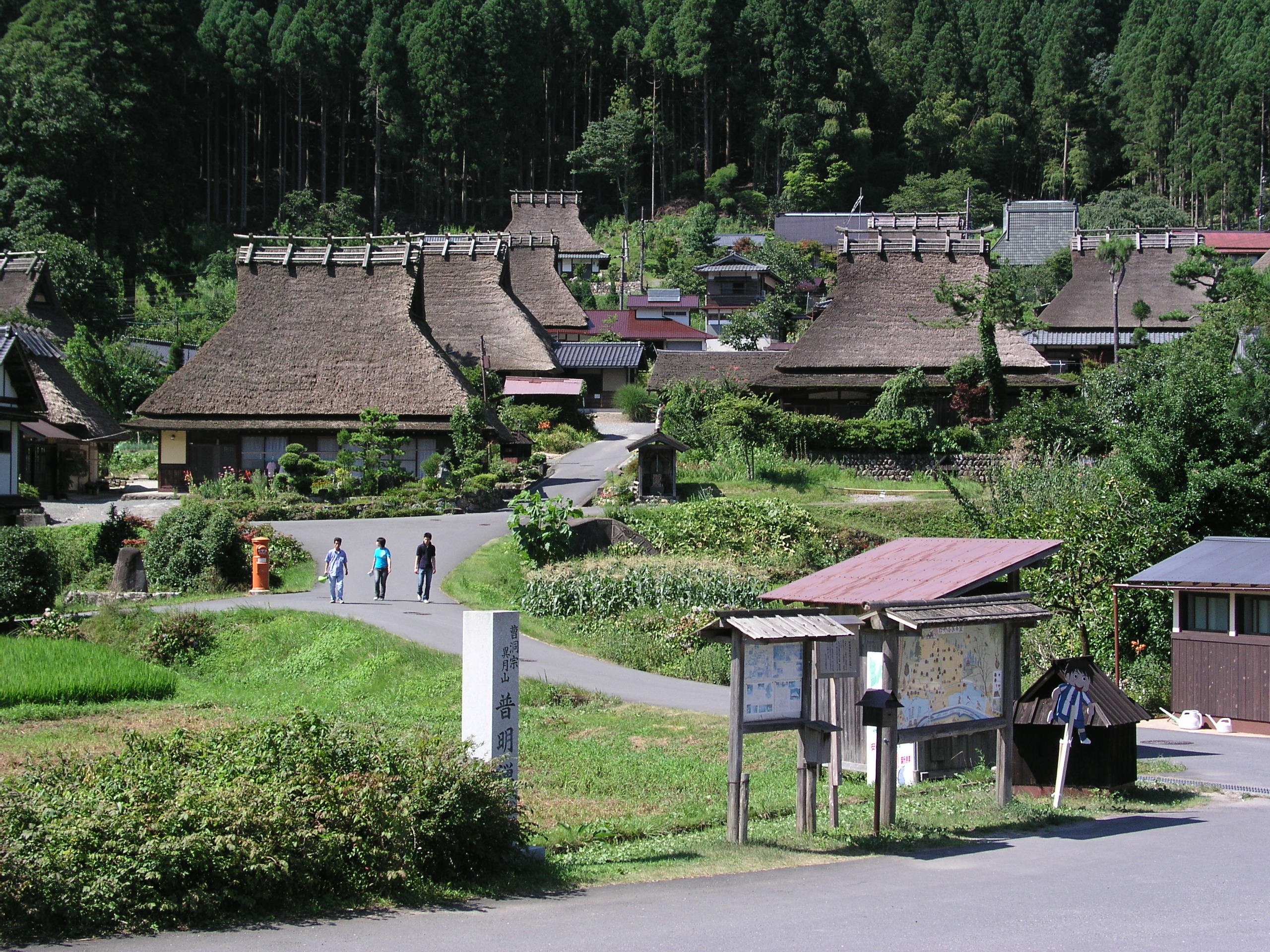 The Kita hamlet in its green season — 39 of the 50 houses are thatched, and all are lived in. Photo: Kansai explorer / Wikimedia Commons, CC BY-SA 3.0

The village, and what is open in winter
Kayabuki no Sato (literally “the thatched village”) is the Kita hamlet of Miyama: 39 thatched houses out of 50, designated an Important Preservation District for Groups of Traditional Buildings on December 8, 1993 (village association). People live in them; it is not an open-air museum, and the lanes are theirs. What you can go into:
- Miyama Folk Museum (美山民俗資料館) — a thatched house opened as a museum: 10:00–16:00, closed Mondays and over New Year, ¥300 adults, under-15s free.
- The Little Indigo Museum is closed from early December to early March — do not plan around it.
- Kaya no Sato (the rest house and shop by the car park) runs 9:00–17:00 with a New Year break; the village café and shops keep short hours and some close on fixed weekdays in winter — the association’s “find” page lists them.
- Twice a year the village tests its fire sprinklers — every house has a water cannon on its roof — and the whole hamlet is cleared of visitors for it. The next test is December 1, 2026 at 11:30 (visitors must leave the village from 11:00 until it ends; car access by prior booking only). It lasts about five minutes and is, if you can time it, the most photographed non-event in Kyoto Prefecture.
Getting there from Kyoto (and why the evening needs a bed)
The village has no station. The official route (village association and Kyoto Prefecture):
- JR Sagano/San-in line, Kyoto → Hiyoshi (日吉) — about 44–52 minutes (local or rapid; some services require a change at Sonobe).
- Nantan City Bus, Miyama–Sonobe line, Hiyoshi Station → “Kita (Kayabuki no Sato)” — about 56 minutes; the tourism office’s model course shows the 9:10 bus arriving 9:56 on weekdays and 10:10 → 11:00 on Sundays. The city bus does not take IC cards (cash or PayPay); a 1-day pass is ¥1,200, 2-day ¥1,500. The timetable is published as a PDF (current edition from April 1, 2026) that we could not read, so we do not quote the per-ride fare or trip count — the office’s own summary is “about 2 hours from Kyoto by JR and city bus”.
- The catch: the last bus back from Kita to Hiyoshi leaves at 18:25 on weekdays, 17:01 on Saturdays and 16:54 on Sundays and holidays (festival site). The lanterns are lit at 17:00. The organizers say it in one line: a day trip by public transport only is not possible. On festival evenings you are staying nearby, driving, or on a tour bus.
Driving: about 80 minutes from Kyoto on Route 162 (the Shuzan highway) or about 90 via the Kyoto Jukan Expressway to Sonobe IC and prefectural road 19. Regular village parking is ¥500 (from April 2027: ¥500 weekdays, ¥1,000 weekends and holidays), 9:00–17:00; on festival evenings only the pre-booked ¥1,500 lot. Winter tyres are mandatory in the organizers’ own words (“必須”), and the village association says the same. Kyoto Prefecture runs a winter road-information page (snow depth, temperature, restrictions, December 1 – March 15) for the roads in — check it the morning you go. Taxis: the tourism office says plainly that there are no taxis waiting at Hiyoshi or Sonobe stations.
 Late November: the last colour before the valley closes down for winter. Photo: 京町家民泊??亭(開業準備中) / Wikimedia Commons, CC BY-SA 4.0

How much snow, how cold (JMA, Miyama station)
Miyama has its own JMA observation station, so these are local numbers, not Kyoto city’s — 1991–2020 normals, retrieved 2026-10-27:
| Month | Mean | Daily high | Daily low | Monthly snowfall | Max snow depth |
|---|---|---|---|---|---|
| December | 4.2 °C | 9.2 °C | 0.7 °C | 26 cm | 15 cm |
| January | 1.7 °C | 6.2 °C | −1.3 °C | 73 cm | 26 cm |
| February | 2.1 °C | 7.0 °C | −1.5 °C | 73 cm | 22 cm |
And the reason for the rename, in the same data: January 2025 recorded only 11 cm of snowfall, while January 2026 brought 79 cm with a minimum of −8.1 °C and February 2026 a 51 cm snow depth. Snow at the festival is a coin toss, not a promise — the lanterns are the fixed part. Dress for an evening standing in the valley at or below freezing: insulated boots with grip, the full winter kit, and a headlamp for the walk back from the car park.
Where to sleep (official listings; book directly)
Lodging is tiny and fills first on festival nights. Prices are the inns’ own published rates as of 2026-10-27; whether a given night is open is something only they can tell you:
- Matabe (またべ) — a farmhouse B&B inside the village: ¥9,900 per adult with breakfast, ¥11,000 during the 2027 festival week; closed over New Year; no solo bookings; reserve by form or phone via Miyama Navi.
- Hisaya (久や) — a whole thatched house inside the village for up to six, ¥30,000 for two adults (official site).
- Kajikaso (河鹿荘) — the hot-spring hotel about 2.5 km down the valley, from ¥13,200 with two meals; it ran guest-only festival shuttles in 2025 and 2026 (nothing posted yet for 2027), has New Year closures, and its open-air bath was out of service from October 2026.
- Miyama Futon & Breakfast — restored thatched houses about 12 km away, ¥20,500–45,000 per person.
Miyama Navi’s stay page lists a dozen more. Because these are family-run and the village is a living hamlet, we do not place booking-platform links here — contact the inns directly, and book the moment the festival dates are public. For a base with more beds, the northern Kyoto coast is its own winter trip: Amanohashidate’s ryokan are two hours away by road. Closer to the city, the other snow-night spectacle in northern Kyoto is Kifune Shrine’s snow-day-only lantern light-up, half an hour from Demachiyanagi on the Eizan line — Kibune & Kurama in winter.
Taking the tour from Kyoto? Then the sensible bed is in Kyoto, near the station — browse Kyoto Station-area stays on Booking.com — since the tour drops you back in the city late in the evening and the exact meeting point is only emailed the day before. (Accommodation links on Beyond Kansai are monetized via Stay22 — a booking may earn us a small commission at no extra cost to you. Disclosure.)
Quick FAQ
- When is the Miyama Snow Lantern Festival in 2027? It is now the Winter Lantern Festival (renamed 2026): January 30 – February 6, 2027, lanterns 17:00–19:00, free entry.
- Is there snow? Not guaranteed — the January normal is 73 cm of snowfall (JMA, Miyama), but January 2025 saw just 11 cm, which is why the organizers dropped “snow” from the name.
- Can I see the lanterns on a day trip from Kyoto by train and bus? No. The last bus from the village to Hiyoshi leaves at 16:54–18:25 depending on the day, before the lanterns are lit. Stay nearby, drive (winter tyres required), or take the tourism office’s ¥12,000 bus tour.
- How do I get to Miyama from Kyoto? JR Sagano line to Hiyoshi (44–52 min), then the Nantan city bus to “Kita (Kayabuki no Sato)” (about 56 min; cash/PayPay, no IC cards; 1-day pass ¥1,200). About two hours door to door.
- Can I park at the festival? Only with a pre-booked ¥1,500 space (80 cars), lot open 16:00–19:00. No shuttle buses.
- Is the village worth visiting in winter outside the festival? Yes — the folk museum is open (closed Mondays), the roofs are the attraction, and the December 1, 2026 sprinkler test is a sight of its own. Most shops keep short winter hours.
Editor’s note
This is an event-and-access guide built from official sources and makes no personal-experience claims — Miyama is not among the areas our editor covers from personal visits. Checked 2026-10-27: the 2027 festival’s dates, hours, name change, parking terms, “no direct bus / no shuttle” statements and the last-bus times on the festival’s official site and FAQ and on Miyama Navi’s event listing; the 2026 edition’s dates on Kyoto City Tourism Association’s event page; access routes, bus durations and the city-bus pass prices on the village association’s and Nantan City’s pages; the house count, 1993 designation, museum hours and winter closures on the village association’s site; the December 1, 2026 sprinkler test on Miyama Navi and the association’s news; inn prices on Miyama Navi’s stay listings and the inns’ own sites; snow and temperature normals and 2025–26 actuals from the JMA’s Miyama station. The city-bus per-ride fare and trip frequency are in PDFs we could not read — confirm at Hiyoshi. Drafted with AI assistance and editor-verified.
Sources
- Winter Lantern Festival 2027 — official site (dates, hours, parking, no direct bus; retrieved 2026-10-27) / FAQ — official (last buses, no public-transport day trip, winter tyres) / English page — official (“Miyama’s Thatched-Roof Village Winter Lantern Festival”)
- Winter Lantern Festival 2027 — Miyama Navi event listing (retrieved 2026-10-27) / Sprinkler test December 1, 2026 — Miyama Navi / Same — Kayabuki no Sato association news
- Winter Lantern Festival 2026 (Jan 19–23) — Kyoto City Tourism Association event page (retrieved 2026-10-27)
- About the village (50 houses / 39 thatched, 1993 designation) — Kayabuki no Sato association official (retrieved 2026-10-27) / Visit (access: Kyoto → Hiyoshi 44–52 min, bus 56 min, winter tyres) / Find (museum hours, shop hours, indigo museum winter closure)
- Public-transport access (“about 2 hours”) — Miyama Navi official / Nantan City Bus passes (¥1,200 / ¥1,500; no IC cards) — Nantan City official (retrieved 2026-10-27)
- Matabe — Miyama Navi stay listing (¥9,900; festival week ¥11,000; retrieved 2026-10-27) / Hisaya — official / Kajikaso — booking page (from ¥13,200) / Miyama Futon & Breakfast — official / All stays — Miyama Navi
- Kyoto Prefecture winter road information (snow depth, restrictions Dec 1 – Mar 15)
- JMA 1991–2020 normals — Miyama station (temperature, snowfall, snow depth; retrieved 2026-10-27)
- Kyoto by the Sea — Beyond Kansai / Kansai autumn beyond Kyoto — Beyond Kansai