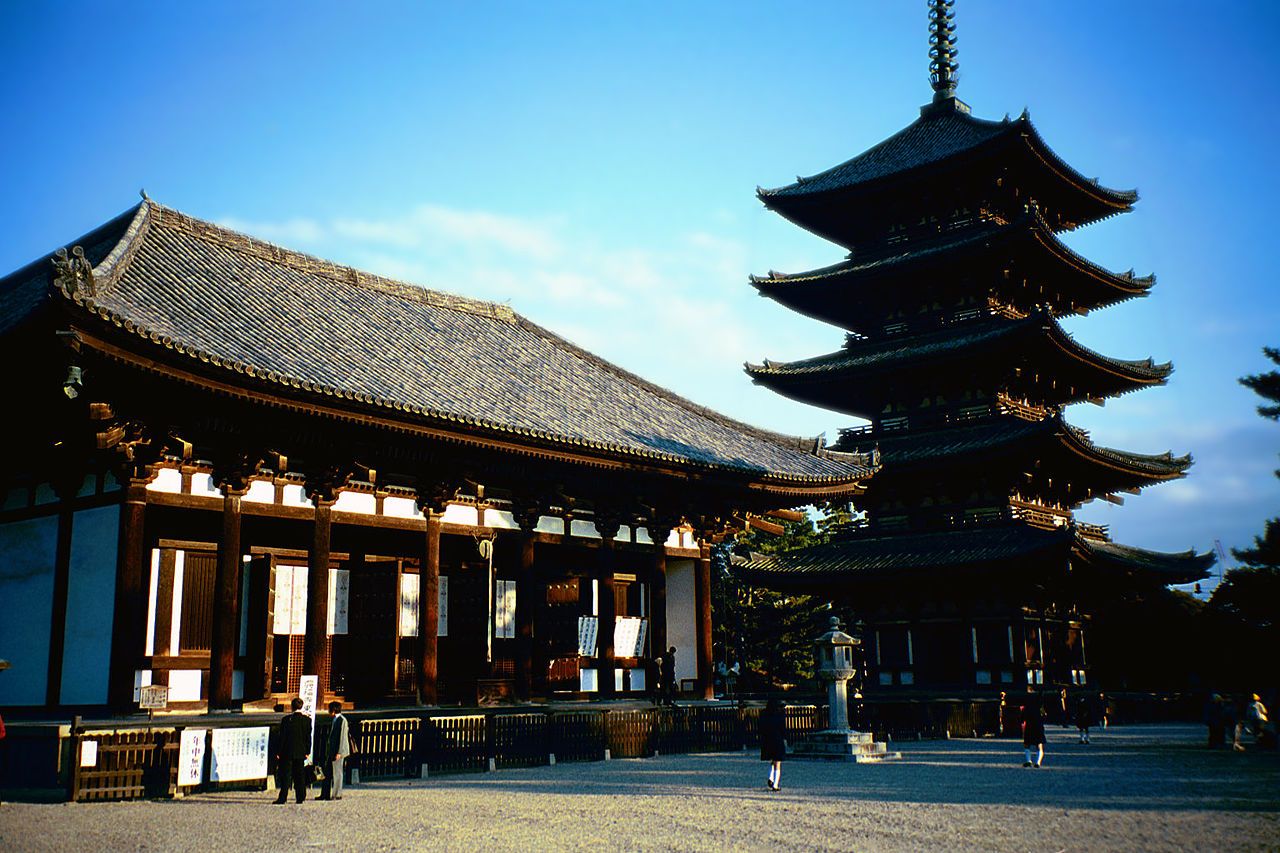
Nara is the day-trip almost every Kansai itinerary squeezes in: ride 45 minutes from Osaka or Kyoto, feed the famous deer, photograph the Great Buddha, leave. It’s a shame, because Nara was Japan’s first permanent capital, it holds an extraordinary density of World Heritage sites, and — right now — it’s in the middle of a quiet luxury renaissance, complete with a Meiji-era prison reopening as one of the country’s most talked-about hotels. Give it an overnight and Nara stops being a photo op and becomes one of the most rewarding cities in Japan.
The day-trip core (do this, but don’t stop here)
Nara Park is a vast 660-hectare green expanse in the center of the city, home to more than 1,400 wild deer (the July 2025 survey counted a record 1,465) — a designated National Natural Monument, traditionally regarded as sacred messengers of the gods. You can feed them shika senbei crackers, and many of the deer have famously learned to bow for them (a polite nod gets you a polite nod back — usually). Within walking distance sit three of the city’s UNESCO highlights:
- Tōdai-ji, whose Daibutsuden hall houses Japan’s ~15 m bronze Great Buddha, cast under Emperor Shōmu in the 8th century; the hall remains one of the largest wooden buildings in the world. Don’t miss the “Buddha’s nostril” pillar with a hole said to grant good fortune to those who can squeeze through.
- Kōfuku-ji, with its National Treasure five-storey pagoda (a symbol of the city skyline) and the famous, hauntingly serene Ashura statue in its treasure hall.
- Kasuga Taisha, a vivid vermilion shrine famous for its thousands of stone and bronze lanterns, lit en masse during the Mantoro lantern festivals.
Why Nara matters: the first capital
From 710 to 784, Nara — then Heijō-kyō — was Japan’s capital, laid out on a Chinese-style grid modeled on Chang’an. You can walk the vast, open Heijō Palace Site, a UNESCO component with reconstructed monuments including the great Suzakumon gate and the Daigokuden audience hall, which give a real sense of the scale of the ancient court. At Tōdai-ji’s Shōsōin repository, treasures from the 8th century — textiles, instruments, glassware traded along the Silk Road — have been preserved so well that they still inform reconstructions of imperial regalia today. This is the layer most day-trippers skip, and it’s the one that explains everything else.
Beyond the park: the Nishinokyo temples
A short trip west of the center, the Nishinokyo district holds two more of the “Historic Monuments of Ancient Nara”: Yakushi-ji, with its graceful paired pagodas and brightly restored halls, and Tōshōdai-ji, founded by the blind Chinese master Ganjin (Jianzhen), who crossed to Japan after five failed attempts to bring Buddhist precepts. They’re quieter than the deer park and richly atmospheric — ideal for travelers who want depth over selfies.
The headline act: a prison reborn (2026)
Here’s the news putting Nara back on the map. The former Nara Prison — the only surviving structure of the Meiji government’s “Five Great Prisons,” commissioned in 1908 with striking red-brick architecture — is being reborn as HOSHINOYA Nara Prison, opening June 25, 2026, with a dedicated Nara Prison Museum that opened ahead of it in April 2026. The hotel will offer 48 suites (including a “10-Cell” suite built from ten original solitary cells) with rates starting around ¥147,000 a night, and embraces a kintsugi-like philosophy of weaving “the scars of a difficult past” into the experience rather than hiding them. Whether or not you stay, the on-site museum makes the history accessible — a genuinely novel reason to visit Nara in 2026.
Nara’s quiet luxury wave
Nara long lacked high-end lodging; that’s changed fast.
- Shisui, a Luxury Collection Hotel (opened 2023) occupies the former Nara Prefectural Governor’s Office at the western edge of Nara Park — 1920s Taishō-era architecture blended with contemporary design (with Kengo Kuma involvement), preserving even the room where the 1951 San Francisco Peace Treaty was ratified. About half the rooms have private hot-spring or open-air baths.
- Fufu Nara is an intimate 30-suite retreat designed by Kengo Kuma, with private open-air onsen baths in every suite — secluded yet right by the park.
Our take (opinion): these stays are the single best argument for turning Nara from a half-day into an overnight. The park and temples are magical in the early morning and evening, after the day crowds clear — and you can only see that if you sleep here.
If you do stay, three honest tiers (bookable examples, not a ranking) — the splurge, the classic mid-range, and the practical value pick. Rates swing with season; treat listed prices as date-dependent.
Book ahead · Klook
Fufu Nara — luxury ryokan
The splurge — the modern luxury ryokan described above.
Check availability →Affiliate link — a small commission may go to Beyond Kansai at no extra cost to you. Disclosure.
Book ahead · Klook
Asukasou — ryokan by Nara Park
The classic mid-range — a long-standing ryokan on the park’s edge.
Check availability →Affiliate link — a small commission may go to Beyond Kansai at no extra cost to you. Disclosure.
Book ahead · Klook
Onyado Nono Nara — natural onsen hotel
The practical value pick — a modern hotel with natural hot-spring baths near the station.
Check availability →Affiliate link — a small commission may go to Beyond Kansai at no extra cost to you. Disclosure.
Naramachi: the old town with hidden depth
South of Kōfuku-ji, Naramachi is a lattice-fronted former merchant district of machiya townhouses, now full of cafés, craft shops, small museums, and quiet temples (including Gangō-ji, another UNESCO component, one of Japan’s oldest temples). It’s where Nara’s culture gets interesting and a little offbeat — preserved townhouses you can step inside, migawari-zaru “lucky monkey” charms hanging from the eaves, and the gateway to one of the city’s most underrated stories: Nara as the birthplace of Japanese medicine (see our dedicated guide).
Festivals and seasons
Nara’s calendar rewards repeat visits. The most spectacular event is the Wakakusa Yamayaki (held on the fourth Saturday of January): at 6:30 PM, signaled by conch-shell horns, around 300 people set the entire grassy hillside of Mt. Wakakusa ablaze, with fireworks — a startling, primal sight visible across the city. Spring brings cherry blossoms across the park; autumn turns the hills around Kasuga and Mt. Wakakusa to gold and red. The Tōdai-ji area’s Omizutori rituals (early March) and Kasuga’s lantern festivals round out a year that’s far more than deer and the Daibutsu.
What to eat
Nara’s signature dish is kakinoha-zushi (persimmon-leaf-wrapped pressed sushi). Look also for sweets and dishes made with Yoshino kuzu (kudzu starch), narazuke (vegetables pickled in sake lees), and miwa sōmen thin noodles from nearby Sakurai. Nara is also widely cited as a birthplace of refined Japanese sake (the brewing methods of Shōryaku-ji), and the city has a surprisingly lively modern curry scene.
Getting there & around
- Trains: ~45 minutes from both Osaka (Kintetsu/JR) and Kyoto — extremely easy. Kintetsu Nara Station drops you closest to the park.
- Around: the Nara Park core is walkable; buses and short taxi hops reach Heijō Palace, Nishinokyo, and Naramachi.
Quick FAQ
- Is a day trip enough? It’s the common choice, but an overnight (early-morning park, evening Naramachi) is far better.
- What’s new for 2026? HOSHINOYA Nara Prison (hotel opens June 25, 2026; museum opened April 2026).
- Where to stay in luxury? Shisui (former Governor’s Office) or Fufu Nara (Kengo Kuma).
- Beyond the deer and Big Buddha? Heijō Palace Site, the Nishinokyo temples (Yakushi-ji, Tōshōdai-ji), Naramachi, and the medicine heritage.
- When’s the mountain-burning festival? Wakakusa Yamayaki, the fourth Saturday of January.
Editor’s note
This guide is built from researched, sourced facts. Nara Park’s deer and UNESCO temples (including the Nishinokyo and Gangō-ji components), the Heijō-kyō capital dates and palace reconstructions, the HOSHINOYA Nara Prison opening dates and history, the Shisui/Fufu details, and the Wakakusa Yamayaki timing were verified against the sources below; the “stay overnight” recommendation is flagged as opinion. A separate guide covers Nara’s medicine heritage. Partially drafted with AI assistance and editor-verified.
Sources
- Todaiji — JNTO / Nara Park guide — JeePe / Kasuga Taisha — JNTO
- Historic Monuments of Ancient Nara — UNESCO / Heijō Palace — Wikipedia / Heijo Palace — japan-guide
- HOSHINOYA Nara Prison — Hospitality Net / Former Nara prison hotel — Travel Tomorrow
- Shisui — Marriott / Shisui — curatedkyoto
- Wakakusa Yamayaki — japan-guide / Mt. Wakakusa Yamayaki — JNTO