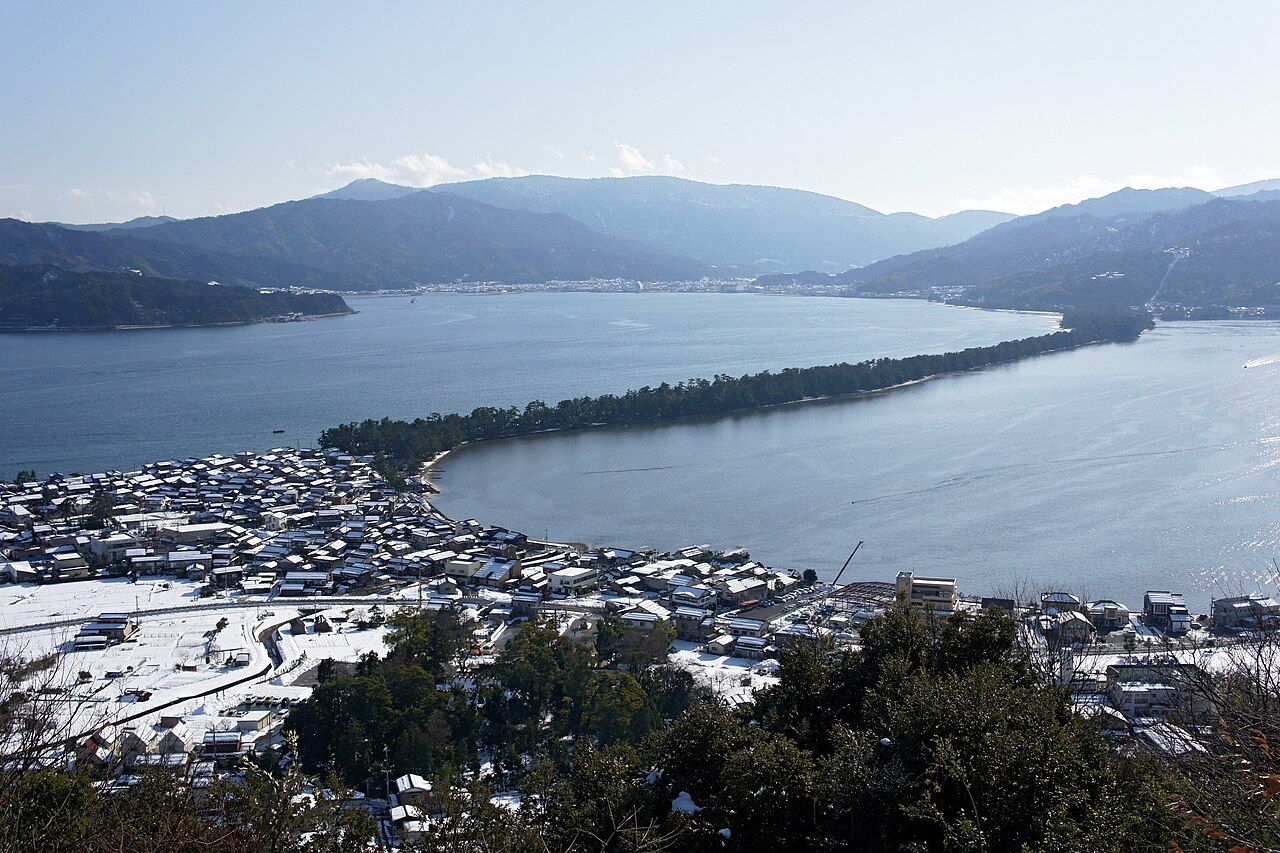
For more than a thousand years, Japanese travelers have ranked Amanohashidate among the country’s three most beautiful views (Nihon Sankei) — the equal of Matsushima and Miyajima. It’s a long, impossibly slender sandbar, thick with pines, dividing Miyazu Bay almost in two, and from the hills above it looks uncannily like a bridge suspended between earth and sky. Hence the name: Ama-no-hashidate, “the bridge to heaven.” Here’s how to actually do it — both ends, the famous upside-down look, and the surprisingly fun culture around it.
Crossing the sandbar (don’t just look — go across it)
The sandbar is about 3.6 km long and lined with thousands of pine trees, and walking across it is part of the experience — figure on roughly 45 minutes on foot, or under 20 minutes by bicycle. Rental bikes near Amanohashidate Station are inexpensive (typically a few hundred yen per hour — check current rates at the station shops), and pedaling the pine-shaded path with the sea on both sides is genuinely lovely. In summer there are small swimming spots along the bar.
Our take (opinion): rent a bike. Walking the full 3 km and back eats most of a day; cycling lets you cross, explore both hillside viewpoints, and still have time for the shrines and lunch.
The “matanozoki” — viewing heaven upside-down
The signature ritual is matanozoki: stand with your back to the bay, bend forward, and look at the sandbar upside-down from between your legs. Inverted, the strip of pines seems to lift off the water and float in the sky — the “bridge to heaven” effect. People have been doing this here for over a millennium, so don’t be shy; everyone’s doing it.
The two viewpoints — which end should you climb?
The classic views are from hills at each end of the bar, and they’re genuinely different:
Kasamatsu Park (north side) — reached by cablecar or chairlift, this is the birthplace of matanozoki and the spot where the sandbar is said to resemble the kanji for “one” (一). It pairs naturally with the north-side shrines and temples (below), and has the more traditional, contemplative feel.
Amanohashidate View Land (south side) — just behind Amanohashidate Station, reached by chairlift or monorail, this is a small hilltop amusement park (Ferris wheel, go-karts, light rides) where the sandbar is said to look like a flying dragon. It’s the easier, more family-friendly option and the quickest from the station.
Our take (opinion): if you only do one, pick Kasamatsu (north) for the classic view plus the shrines; choose View Land (south) if you’ve got kids or want the fastest payoff straight off the train. With a bike, do both.
Chion-ji: the temple of wisdom
At the southern foot of the sandbar sits Chion-ji, Amanohashidate’s most influential temple, dedicated to Monju, the Buddha of wisdom. It’s a place students and parents come to pray for academic success: you’ll see distinctive fan-shaped paper fortunes (omikuji) tied up around the grounds, and the local sweet souvenir is “chie-no-mochi” (wisdom mochi). The cruise dock for the bay sits right beside it.
North-side culture: the “original Ise” and a mountain temple
If you cross to the north end, two more sights reward the trip up from Kasamatsu:
- Motoise Kono Shrine is said to have enshrined the sun goddess Amaterasu before she was permanently moved to the Grand Shrine at Ise — hence “Motoise,” the original Ise. For anyone interested in Shinto history, that’s a remarkable pedigree.
- Nariai-ji, a mountain temple reached by shuttle bus above Kasamatsu, offers one of the highest and finest panoramas over the whole sandbar and bay.
The bay cruise
A sightseeing boat crosses Miyazu Bay between the two ends, giving you the sandbar from sea level (and a chance to feed the wheeling gulls). It’s an easy way to make a loop: cycle one way, cruise back — or vice versa.
Getting there
The Limited Express Hashidate runs directly from Kyoto Station to Amanohashidate in about 2 hours (seat reservation required); from Osaka, the Konotori connects via Fukuchiyama. Note that the nationwide JR Pass doesn’t cover the Kyoto Tango Railway section, while the Kansai WIDE Area Pass does (sold on Klook as well as JR West’s own site — affiliate link; small commission possible at no extra cost to you, disclosure) — every route, fare and the highway-bus alternative are in our dedicated access guide, and our Kyoto by the Sea guide covers combining Amanohashidate with Ine and the Tango coast. Prefer a no-transfer day instead? Guided tours from the Kyoto side include the transport — see current Amanohashidate tours on Viator. (Affiliate link — a small commission may go to Beyond Kansai at no extra cost to you. Disclosure.)
Staying near the sandbar: Miyazu’s seaside ryokan and hotels put you a walk from the morning viewpoints before the tour buses arrive — browse Amanohashidate & Miyazu stays on Booking.com. (Accommodation links on Beyond Kansai are monetized via Stay22 — a booking may earn us a small commission at no extra cost to you. Disclosure.)
When to go & tips
- Spring/autumn: the most comfortable for cycling and the viewpoints.
- Summer: add a swim along the sandbar.
- Go earlier in the day to beat the tour groups at the viewpoints, and leave time for the souvenir-and-seafood streets near the station — the area is dense with local catch.
Quick FAQ
- Walk or cycle the sandbar? Cycle (¥500/2 h) unless you specifically want the slow walk — it frees up time for both viewpoints.
- North or south viewpoint? Kasamatsu (north) for the classic view + shrines; View Land (south) for families and quick access.
- What’s matanozoki? Viewing the sandbar upside-down between your legs — it makes the pines look like a floating bridge.
- Anything cultural? Chion-ji (wisdom), Motoise Kono Shrine (the “original Ise”), and Nariai-ji’s high view.
- How long do I need? Half a day for the sandbar + one viewpoint; a full day to do both ends, the shrines, and a cruise.
Editor’s note
This guide is built from researched, sourced facts. The Three Views status, sandbar length and walk/cycle times, matanozoki, the two viewpoints, Chion-ji’s wisdom associations, Motoise Kono Shrine and Nariai-ji, and access details were verified against the sources below. The “rent a bike” and “which viewpoint” recommendations are flagged as opinion. Partially drafted with AI assistance and editor-verified.
Sources
- Amanohashidate Sandbar — japan-guide / Amanohashidate — JNTO / Amanohashidate travel guide — japan-guide
- Amanohashidate — tourism association official (sights, cycling; replaced dead link, retrieved 2026-08-31) / Sandbar cycling to shrines — Adventure.com
- Amanohashidate guide — Rakuten Travel / Getting to Amanohashidate — japan-guide