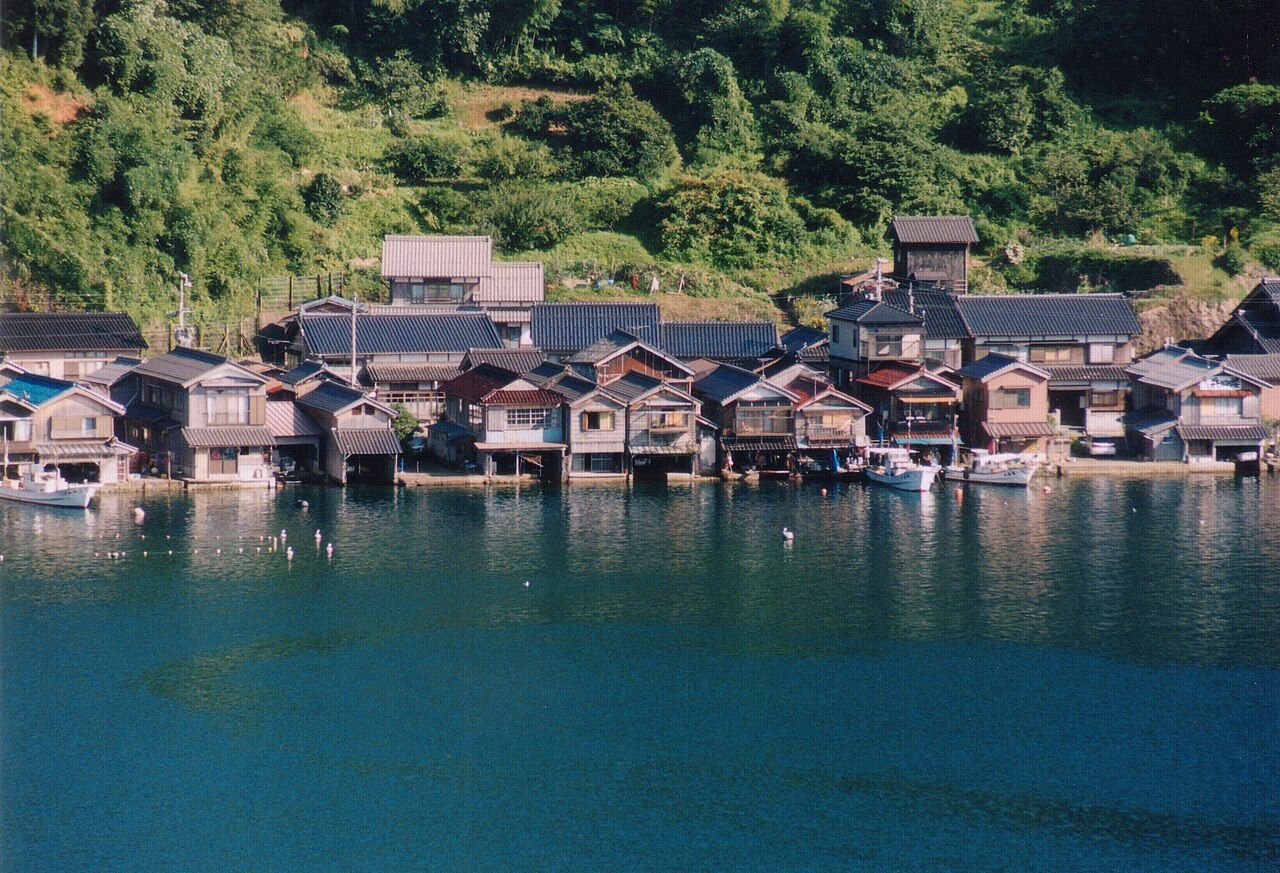
Most visitors meet Ine the same way: they ride the 25-minute sightseeing boat around the bay, photograph the boathouses from the water, and leave on the afternoon bus back to Amanohashidate. It’s lovely — and it’s the shallow version. Ine only really reveals itself after the day-trippers go home, when the bay goes glassy, the light turns gold, and the village of roughly 230 boathouses settles back into being a working fishing community rather than a viewpoint. The way to see that is to sleep in one.
Here’s what staying in a funaya is actually like, what it costs, and how to book — including the parts the brochures leave out.
First, what a funaya actually is
Ine’s funaya (literally “boat houses”) line about 5 km around Ine Bay — roughly 230 of them, standing with their feet in the sea. Each is a two-storey building: the ground floor is a garage that opens directly onto the water for the family’s boat, and the upper floor is the living space. The bay is unusually calm — sheltered by a small island across its mouth and ringed by hills — which is the whole reason a village could be built right at the waterline. A number of these houses have been converted into minshuku (family-run guesthouses) and small inns, so you can sleep directly above the water where a fishing boat used to be parked.
Why bother staying the night?
Our take (opinion): the overnight is the entire point of Ine. By late afternoon the tour boats stop and the bus crowds thin out, and you’re left with a near-silent bay, fishermen actually working, and the kind of evening-and-morning light that the midday day-trip never sees. You wake up to the sound of water under the house. If you only have time for the boat loop, Ine is a pretty photo; if you stay, it’s a memory.
What to expect inside (the honest version)
Set expectations correctly and you’ll love it; arrive expecting a hotel and you won’t. A typical Ine minshuku is a traditional Japanese-style stay:
- Tatami rooms with futon bedding — and at simpler places you may lay out and put away your own futon.
- Bathing in the evening, often in a shared bath, with toilet and washing facilities sometimes shared with other guests (one funaya guesthouse even has its own onsen bath).
- Dinner and breakfast served in a common dining room, home-style.
It’s intimate and personal — at some places the owner (“landlady”) personally guides you through the village’s history and sightseeing. That hospitality is the trade-off for the lack of hotel-style privacy.
At the other end of the scale, several funaya have been turned into higher-end converted inns with sea-view rooms, private bathrooms, even saunas (e.g. Funaya Kura), and adults-only retreats with bay views (e.g. Taiheisou). So “staying in a funaya” spans everything from rustic family minshuku to boutique waterfront ryokan.
The food: this is a fishing village, so eat like one
The reason to take the meal plan is simple — the seafood is landed locally and served fresh. Funaya guesthouses lean hard into their catch, with seasonal dishes featuring fish like yellowtail (buri) and red snapper, and home-cooked spreads that are usually the highlight of the stay. When dinner is included, you’ll typically eat a multi-dish home-style meal in the common room. (Confirm at booking whether your rate includes dinner — some places do breakfast only or no meals.)
What it costs
For a traditional minshuku, plan on roughly ¥5,000–14,000 per person per night including a home-style dinner and breakfast — a genuinely good-value way to experience this. The converted-funaya boutique inns run higher (sea-view rooms, private baths, and similar push prices up), so Ine spans budget to splurge depending on the property.
Reality check (opinion): the cheap end is honest, simple minshuku — not a discounted version of the design-magazine funaya you saw online. Decide which experience you want before you book, because they cost and feel very different.
Booking: this is the part people get wrong
Book early. Really early. Ine is small, the number of guest funaya is limited, and demand is high, so the village tends to be fully booked year-round — aim to reserve at least two months in advance, more for weekends and crab season. Reservations are made online or directly with the individual owners; some of the most characterful funaya aren’t on the big international booking sites at all, so it’s worth checking the property’s own page or the official Ine accommodation listings.
The math is the whole story. These aren’t hotels with room inventory — they’re converted family houses. Maruichi has exactly one guest room (sleeping 2–8, roughly ¥17,600–22,000 per person, per its official site — checked 2026-09-16), so its entire nightly capacity is one booking. Taiheisou has two rooms, both bay-view, and runs adults-only. The town’s own accommodation directory even has a filter category for “one group per day” inns. When a village’s inns each sell out on a single reservation, there is no slack to absorb demand — that’s why the two-month lead time isn’t cautious advice, it’s arithmetic. If either appeals, check them by name for your dates: Funaya no Yado Maruichi on Booking.com · Taiheisou on Booking.com.
Where to look: browse Ine stays on Booking.com for the internationally listed funaya and inns on your dates, then cross-check the official Ine listings above for the owner-direct places that never appear on the platforms — the five extra minutes routinely turns up rooms the big sites say don’t exist. Or scan what’s available around the bay on the map below. (Accommodation links and the map on Beyond Kansai are monetized via Stay22 — a booking may earn us a small commission at no extra cost to you. Disclosure.)
Getting there
Ine has no train station. From Kyoto, take the Limited Express Hashidate to Amanohashidate (~2 hours), then a Tankai bus to Ine (about 60 minutes); buses stop first at the cruise pier, then the town center. A taxi from Amanohashidate runs roughly ¥5,000–7,000. If you’re continuing onto the Tango beaches or visiting in winter, a rental car picked up at Amanohashidate Station is the most flexible option. (Every route, fare and the seasonal direct bus: How to get to Ine from Kyoto; coming via the sandbar first: Amanohashidate from Kyoto; the wider region: Kyoto by the Sea.) One more argument for the overnight: it deletes the day-tripper’s tightest constraint — the last buses back out of Ine are what everyone else plans their day around. Day-trip visitors who’d rather not manage the train-bus transfer can also reach this coast on a guided tour with transport included — current Amanohashidate-area tours on Viator — though for the overnight itself, the bus is the way. (Affiliate link — a small commission may go to Beyond Kansai at no extra cost to you. Disclosure.)
Make the most of being there
- Take the Ine Bay sightseeing boat (~25 min) for the classic from-the-water view — or, better, ask your guesthouse about a “sea taxi” or fishing trip, which most funaya stays can arrange.
- Walk the waterfront lane at dawn and dusk, when the bay is stillest and the day-visitors are gone.
- Build in time to simply do nothing — Ine rewards sitting still more than ticking off sights.
Quick FAQ
- Can you stay in a funaya boathouse? Yes — a number of Ine’s ~230 funaya operate as family-run minshuku and small converted inns, so you sleep in the upper floor of a working boathouse directly over the bay. That experience is exactly what this guide covers.
- How far ahead should I book a funaya stay? Two months minimum; more for weekends and Nov–Mar crab season. The structural reason: the inns are tiny — one or two rooms each (Maruichi has a single guest room; the town directory even filters for “one group per day” inns) — so each night sells out on a booking or two.
- Is it a hotel? No — most are family minshuku with shared facilities. Boutique converted-funaya inns exist too, at higher prices.
- What does it cost? Roughly ¥5,000–14,000 per person/night with two meals at a minshuku; boutique inns more.
- Are meals worth it? Yes — the fresh local seafood dinner is usually the best part. Confirm the meal plan when booking.
- How do I get there without a car? Hashidate limited express to Amanohashidate, then a ~60-minute bus to Ine.
Editor’s note
This guide is built from Japanese-language tourism sources and the official Ine accommodation listings. The number and structure of the funaya, the minshuku format and price range, the booking lead time, the meal/seafood details, and access were confirmed against the sources below; the case for staying overnight and the budget-vs-boutique caveat are flagged as opinion. The named-inn facts — Maruichi’s single guest room and ¥17,600–22,000 per-person rates, Taiheisou’s two bay-view rooms and adults-only policy, and the Ine Tourism Association directory’s “one group per day” inn category — were checked against each property’s official site and the association’s listings on 2026-09-16. Rates and room counts at family-run inns change; confirm when booking. Partially drafted with AI assistance and editor-verified.
Sources
- For Booking Ine (official) — Kyoto by the Sea
- Ine Travel Guide — japan-guide / Ine Fishing Village — JNTO
- Minshuku explained — japan-guide
- Funaya no Yado Maruichi — official (single guest room, 2–8 guests, ¥17,600–22,000/person, bookable; retrieved 2026-09-16) / Taiheisou — official (two bay-view rooms, adults-only retreat, bookable; retrieved 2026-09-16)
- Ine Tourism Association accommodation directory — official (“one group per day” inn filter category; retrieved 2026-09-16)
- Funaya no yado Acchan (official) / Funaya Kura — Booking.com
- Ine hotels overview — Tripadvisor